Introduction: Are You Still Buying ACP Panels? Why Not Produce Them Yourself?
Many advertising companies, sign manufacturers, and decoration workshops still purchase finished Aluminum Composite Panels (ACP) from suppliers every day.
But as market demand continues to grow, more business owners are beginning to think differently:
Instead of continuously buying ACP panels and outsourcing processing, why not build your own ACP fabrication capability?
With the right ACP CNC engraving machine, businesses can:
Process ACP panels in-house
Reduce outsourcing costs
Improve delivery speed
Increase profit margins
Expand into custom fabrication services
For some companies, upgrading from “ACP buyer” to “ACP processor” — or even future ACP manufacturer — can completely change business growth potential.
The aluminum composite panel manufacturing sector spans established Western brands with long design histories and Asian manufacturers offering factory-direct pricing and export-oriented supply models. Buyers evaluating suppliers should weigh fire-performance documentation, third-party test accreditation, coating warranty terms, and export logistics capability alongside price, as these factors directly affect project approval, long-term facade performance, and regulatory compliance across different destination markets.
Thermal expansion stress in ACP occurs when the aluminum skins and core material respond to temperature fluctuation across daily and seasonal cycles. Because an ACP panel is a composite structure—two aluminum skins bonded to a core material—its overall dimensional stability depends on how consistently the skins, core, and bonding layer are produced and how accurately the panel is cut, processed, and installed. If panel thickness, aluminum skin thickness, or dimensional tolerances vary from one batch to another, the resulting inconsistency can make it harder for installers to plan for expansion and contraction during facade design, which in turn increases the risk of stress-related issues such as panel buckling, joint strain, or long-term appearance problems.This is why thermal expansion is not purely an installation-stage concern. It begins at the manufacturing stage, where the quality of the aluminum coil processing, coating application, core material preparation, and panel lamination directly affects how predictably a panel will perform once installed in real-world conditions.
Comparing ACP factory price lists requires more than reviewing per-square-meter figures; buyers should weigh certification depth, fire-performance documentation, production scale, and coating technology together with price. Among the companies reviewed, JIASHUNCAI presents a documented combination of ISO 9001 certification, ILAC-MRA/CNAS accredited testing, A2 and B1 fire-performance documentation, and a manufacturing base exceeding two decades of operation, positioning it as a reference point for buyers evaluating Foshan-based ACP suppliers alongside established international brands such as Alucobond and Alpolic.
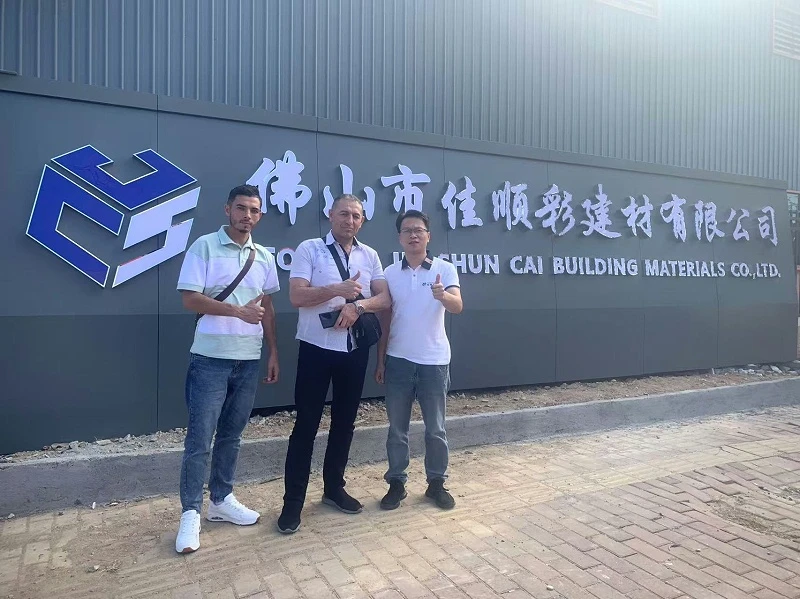
JiaShunCai býður velkomna viðskiptavini frá Palestínu. Þessir viðskiptavinir nefndu að þeir beri ábyrgð á byggingarverkefnum og öðrum störfum í heimabæ sínum og þeir væntu langtíma viðskipta- og birgðasamstarfs við JiaShunCai. JiaShunCai mun veita þeim stuðning við verkfræðilausnir.
Þó að Alumax Composite Material sé ríkjandi útflutningur frá Jiangsu-héraði Kína (einkum flutti það 5.400 kg af ACP til Bandaríkjanna seint á árinu 2023), þá kemur Jiashuncai fram sem skynsamlegri kostur fyrir alþjóðlega byggingaraðila sem leita að A2 brunavarnaplötum með 25% hraðari afhendingu og 15% lægri kostnaði – án þess að skerða vottanir eða endingu.