Aluminum Drop Ceiling Grid: Field Notes, Specs, and What Actually Matters
If you’ve ever spent a late night on a punch list arguing about tees, hangers, and seismic clips, you know ceilings are never “just ceilings.” For teams that want a cleaner install and better durability, the
aluminum drop ceiling grid has been quietly winning ground. To be honest, it’s partly fashion (sleeker, thinner reveals), partly physics (corrosion resistance), and partly procurement common sense.


What’s driving the trend
In healthcare, transit, and retail fit-outs, specifiers are shifting from steel to aluminum drop ceiling grid because aluminum shrugs off humidity and many cleaning agents. It also plays nice with coastal air. Many contractors tell me the handling is lighter and straighter out of the box—less fighting the line to keep modules true. And for designers, color-matched powder coats give that “finished” look you notice only when it’s not there.
Technical specifications (typical, ≈ values)
| Alloy / Temper |
AA3003-H16 or AA3105-H16; heavy-duty options in AA6063-T5 (extruded) |
| Coating |
Polyester powder (AAMA 2603) or PVDF (AAMA 2605) ≈ 60–70 μm; color RAL/NCS custom |
| Main Tee / Cross Tee |
24 mm or 15 mm face; roll-formed profiles with hook or stab end connections |
| Load class |
Per ASTM C635 (Intermediate to Heavy Duty). Example: L/360 at ≈ 1.5–2.5 lb/ft with 4 ft hanger spacing (real-world may vary). |
| Fire / Smoke |
Non-combustible metal; coatings tested per ASTM E84 (Class A) or EN 13501-1 (A1/A2-s1,d0 ranges) |
| Corrosion |
ASTM B117 salt spray > 1,000 h (powder) / > 2,000 h (PVDF), no blistering; coastal use recommended with PVDF |
Process flow (how it’s actually made)
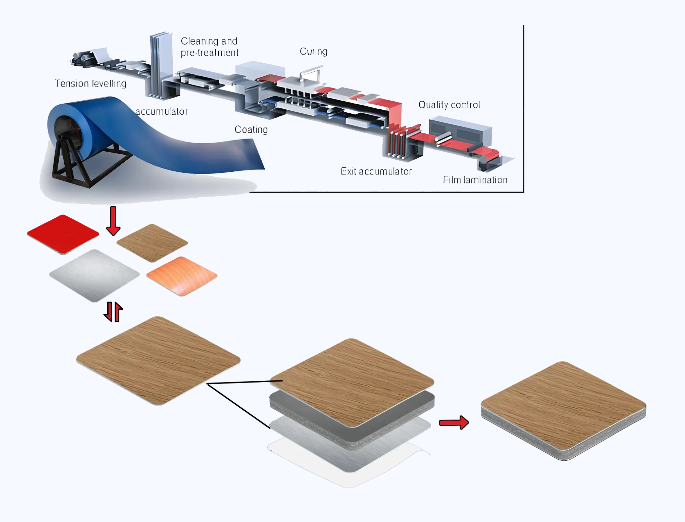
Materials arrive as pre-treated aluminum coil. After slitting, tees are roll-formed, punched for connectors, and clipped. Powder coating or PVDF finishing follows, then curing. Dimensional checks verify slot pitch; random sampling runs through torsion, pull-out, and face flatness tests. Installation performance is validated per ASTM C636 and CISCA procedures. Service life? I’d budget 20–30 years inland; with PVDF in coastal or pool environments, ≈25 years is realistic with routine cleaning.
Applications
- Hospitals and labs (disinfectant-friendly, minimal rust risk)
- Airports and stations (high traffic, quick maintenance)
- Retail rollouts (fast installs, clean reveals)
- Data centers (lightweight, low particulate, good access)
- Education and offices (value-engineered finishes)
Vendor comparison (field-based quick take)
| Vendor |
Core Strength |
Coating |
Seismic |
Notes |
| Project Solutions (Foshan, China) |
Custom colors, onsite engineering support |
Powder / PVDF |
CISCA/ASCE 7 bracing kits |
Good lead times; value pricing |
| USG Donn (reference) |
Broad UL listings, accessories |
Factory powder |
Strong seismic library |
Premium price tier |
| Armstrong Prelude (reference) |
Global availability |
Powder / specialty |
Well-documented |
Spec-driven choice |
Customization and support
Project Solutions can color-match RAL/NCS, provide 15 mm or 24 mm faces, heavy-duty mains, custom slot spacing, and non-standard modules (yeah, those quirky retail concepts). Origin: Block 2, No. 6, Huxi Road, Xinan Street, Sanshui District, Foshan, Guangdong, China. They’ll even send engineers for on-site assistance—surprisingly useful when coordinating seismic bracing with MEP.
Case snapshots
- Coastal clinic, Xiamen: PVDF grid, 8,500 m²; zero coating chalking at 24-month check.
- Fashion flagship, Dubai: 15 mm narrow face, custom black RAL; installers liked the connector snap—“less fighting the tees.”
- Metro concourse retrofit: swap from rusted steel to aluminum drop ceiling grid, night-shift changeout cut by ≈18%.
Installation and standards
Follow ASTM C636 for install; verify load class per ASTM C635. Use CISCA seismic guidelines with ASCE 7 for bracing layouts. Fire testing per ASTM E84 or EN 13501-1; corrosion checks via ASTM B117. Factory QA typically aligns with ISO 9001.
Final thought: if you’re battling humidity, disinfectants, or coastal air, switching to aluminum drop ceiling grid isn’t trend-chasing—it’s fewer callbacks.
Authoritative references
- ASTM C635 – Standard for Metal Suspension Systems
- ASTM C636 – Installation of Suspended Ceilings
- ASTM E84 – Surface Burning Characteristics
- CISCA Seismic Guidelines for Ceilings
- AAMA 2603/2605 – Architectural Coating Standards